Write it. Burn it.
The letter they never answer is the one that ends it. Write it here, hold the button to burn it, and it is gone from this browser for good. Expressive-writing research puts the useful dose at fifteen to twenty minutes across a few sessions, and calls the gains modest rather than large.
It’s ash. It was never for them anyway.
letter burned in this browser
Stuck?
Hold it down for a second. Nothing burns by accident.
Your draft is kept in this browser until you burn it.
How this page works
Nothing is scored or graded here. The page is a text box, a hold-to-burn button and a piece of browser storage, and that is the whole of it. Your draft is written to this browser's own storage under one key as you type, so a closed tab or a dead battery does not take the letter with it. Open the page in another browser and the draft is not there.
The burn is a press-and-hold rather than a tap, and the reason is the 1am hand. A single tap next to a text box is one mis-touch away from deleting something you spent twenty minutes on, so the fire only starts once the button has been held down, and letting go early stops it. When it does finish, the storage key is cleared and the letter is gone from this device for good. There is no undo, because an undo would make the burning meaningless.
What the writing itself does is the only part with research behind it. James Pennebaker's expressive-writing work, first published in 1986 and replicated many times since, has people write about an emotional experience for fifteen to twenty minutes across a few sessions and finds modest measurable gains in wellbeing afterwards. Modest is the honest word. It is not a treatment, it does not close a relationship, and the page does not claim it will — it costs twenty minutes and nothing else, which is a good enough reason to try it.
Where these numbers come from
- Confronting a traumatic event: toward an understanding of inhibition and disease — Pennebaker & Beall, Journal of Abnormal Psychology, 1986
Nothing on this site is medically reviewed and nobody here is a therapist. Every figure above was read out of the code that runs on this page, and where a number is our own judgement rather than a published one, the note says so and cites nothing. Method last checked 21 August 2026.
Why writing it beats sending it
The urge to explain yourself to somebody who has stopped listening is not stupidity. It is an unfinished conversation, and your head keeps running it because nothing has closed it. Writing the whole thing down gives the sentences somewhere to go that is not their inbox.
What the research shows
In 1986 James Pennebaker and Sandra Beall asked students to write about an upsetting experience for fifteen minutes on four days, holding nothing back. The people who wrote about the hard thing rather than something neutral were measurably better off months later. Hundreds of studies have run some version of that experiment since. A 2006 meta-analysis in Psychological Bulletin pooled more than a hundred randomized trials and found the benefit real, reliable and small: expressive writing is not treatment, it is a cheap thing that helps a bit and costs you twenty minutes.
What the studies agree on is the shape of it. Write about the event and what it did to you, not just the facts. Keep going for at least fifteen minutes. Do it more than once. Nobody has to read it — in most of the research, nobody ever did. That is the unsent letter, unpacked properly.
Why the letter stays unsent
An audience edits you. The moment a real person is going to read this, you start managing them — softening the ugly part, sharpening the line that would land, editing for a reply you can already picture. The letter stops being what happened and becomes an argument you intend to win.
Sending it also hands them the next move, and the next move is usually another wave. In a daily-diary study, David Sbarra and Robert Emery tracked people through a breakup and found that days with contact carried both more love and more sadness than the days without — the feeling does not fade on schedule when it keeps getting fed. Unsent, the letter does its work on your side of the wall and stops there.
Why burning it helps
A letter you keep is a letter you can reread at 2am, and rereading is how a closed loop reopens. Burning removes the option. It is also the only ending in this that you get to choose the timing of: you decide it is done, and then it is done.
Nothing burns here unless you hold the button down. If tomorrow there is more to say, write another one. Most people do, and the second one usually comes out calmer than the first. If you already sent one, that is a normal thing to do, and it is not the end of the run.
Frequently asked questions
Does my draft survive if I close the tab?
Why burn it instead of sending it?
Does writing to an ex actually help?
Can I keep the letter instead?
What if I have more to say tomorrow?
More tools
Urge Timer
The urge is loudest in the first ten minutes. Start the ring, keep your hands busy, and let it pass without sending anything.
Grey Rock Trainer
Paste the reply you were about to send and see what it gives them. Then draw a flatter one.
Breakup Recovery Timeline
Six questions, no promised date. A phase map built from published research instead of the half-the-relationship rule.
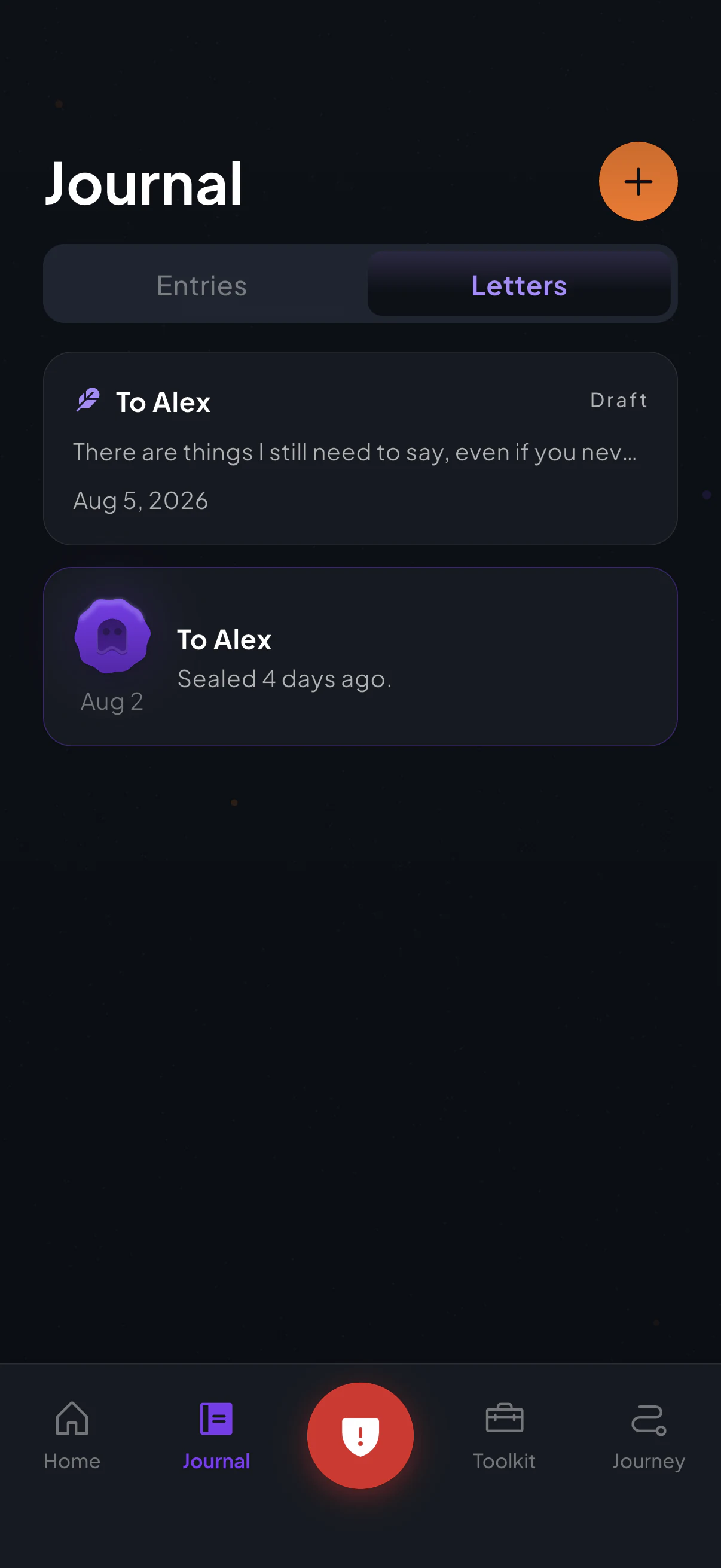
In the app, the letters have a drawer
Ghosted keeps a sealed place for the letters you want to keep, and the same fire for the ones you do not. All of it on your phone, with no account and no server.