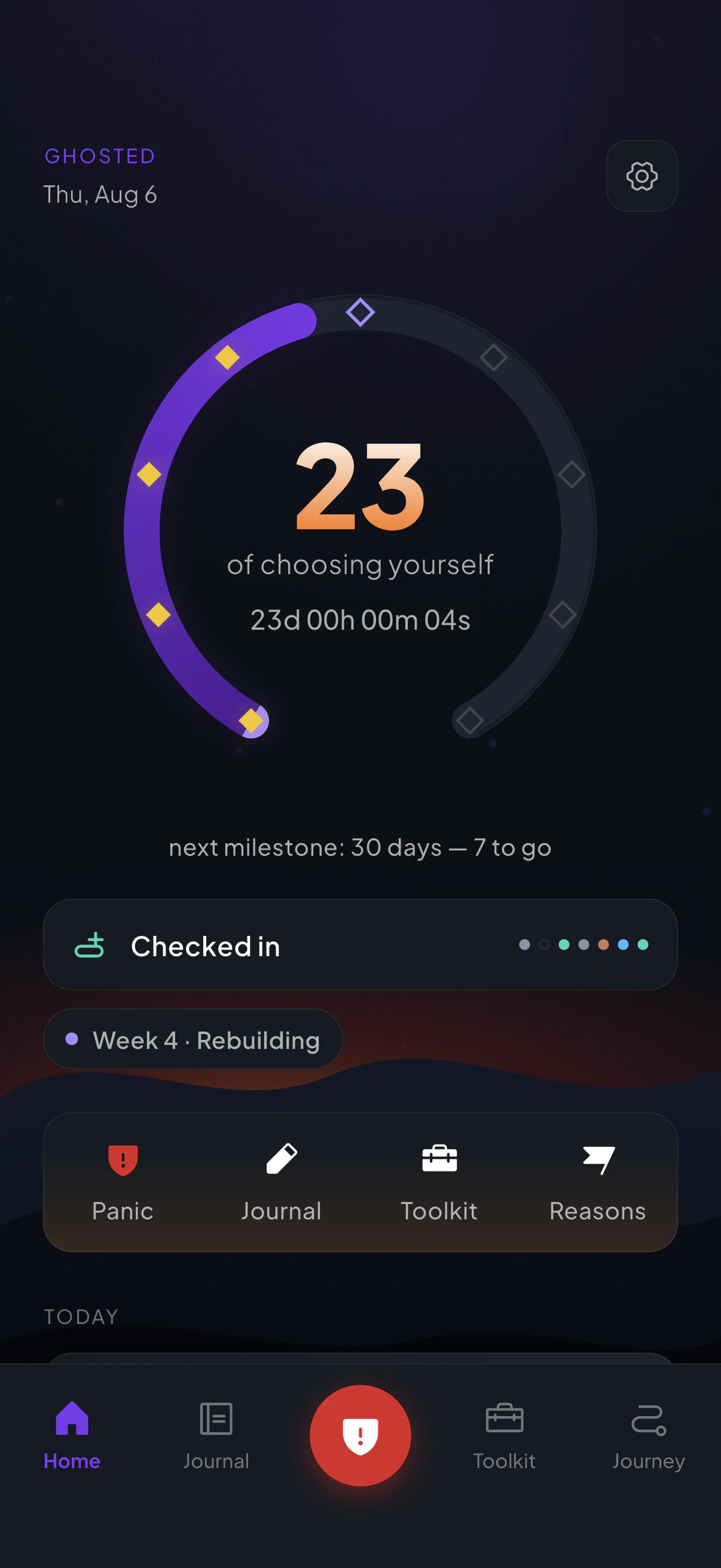
Your no contact day count.
Set the day you last reached out and it counts from there, second by second — not from the day it ended. Nine rungs mark the shape of it, from the first night to a year. Your date rides in the link, so the link is the counter: there is no account, and copying the address is how you keep the count.
—
days no contact
Set a date below and the ring starts.
That date has not happened yet.
Your date is kept in this browser and in the link you copy. Copy the link to carry the count to another device.
The nights worth marking
Nine of them, the same nine the app sets into the ring as gold. Every one is about what happens in you. None of them is about what they do.
-
Day 1 The first night
The worst hours are the ones you are in. Nothing gets decided tonight except that you did not send it, and that is the whole of the work today.
-
Day 3 The pull at its loudest
Urges usually peak somewhere in the first three or four days. They behave like waves — they build, crest and drop whether or not you act on them.
-
Day 7 One week
The physical week is behind you. Sleep tends to come back before mood does, so the first real improvement is one you can nearly miss.
-
Day 14 Two weeks
The urges keep arriving and stop being a surprise. A trigger you can name — the drive home, Sunday afternoon, the hour after your friends leave — is one you can plan around.
-
Day 30 A month
A checkpoint, not an expiry date. What changed, what is still hard, and whether there is any reason to make contact that is not an urge wearing a good excuse.
-
Day 60 Two months
Long enough that the count stops being the first thing you think about. Bad nights still turn up. They turn up further apart, and they end sooner.
-
Day 90 Three months
Most people stop rehearsing conversations that are never going to happen. The story of the ending has more in it than the loop you told yourself in week one.
-
Day 180 Six months
Half a year without giving the wound a fresh reason to open. Sbarra and Emery found that days with contact interrupted the fall of both love and sadness — you have not interrupted it once.
-
Day 365 A year
Every date on the calendar has now happened without them: the birthday, the anniversary, the song, the season. That is the thing a year does that no month can.
Your counter link
Keep it one tap away
iPhone and iPad
- Tap Share in Safari
- Scroll down to Add to Home Screen
- Tap Add
Android
- Tap the three-dot menu in Chrome
- Tap Add to Home screen
- Tap Add
Then write tonight’s note while you are thinking clearly: Read This When hands it back to you at 3am, when you are not.
How the count is worked out
The count is the elapsed time between the moment you set and now, and it is arithmetic on the clock rather than a calendar subtraction: total seconds, then whole days at 86,400 seconds each, then the hours, minutes and seconds left over. It repaints every second while the tab is open. The ring around it is a stroke on a circle of radius 124, about 779 pixels of circumference, filled to the fraction of the way to the next rung.
Your date rides in the link rather than in an account. The address bar is the storage: paste the link on another device and the count is there. A copy is kept in this browser's own storage as well, so the page opens on the right number without the link.
The ladder is nine rungs — the first night, day three, one week, two weeks, a month, two months, three months, six months and a year — and they mark the shape of the thing rather than a schedule. Day three is on the list because urges usually peak somewhere in the first three or four days; the rest are the checkpoints people describe rather than findings. What each rung says is written in PHP and handed to the script, so the rung the server draws and the rung the page redraws cannot drift apart.
Two honest limits. The count measures distance, not worth, and it measures what you did rather than how you feel — a hard day at day forty is not a lower number. And it does not reset itself if you reach out. Twenty-two days of distance did not stop being real because of a text on day twenty-three, and starting again from nothing tends to make a count feel like a punishment, which is when people abandon it. Whether it resets is your decision and the page will not make it for you.
What the number is for is the one part with research under it. Fisher and colleagues (2010) scanned people looking at a photograph of a rejecting partner and found activity in reward and motivation circuitry — the wanting is a craving rather than evidence about fit. And contact is the thing that reliably restarts it: Sbarra and Emery's diary study found more love and more sadness on the days with contact than on the days without.
Where these numbers come from
- Reward, addiction, and emotion regulation systems associated with rejection in love — Fisher et al., Journal of Neurophysiology, 2010
- The emotional sequelae of nonmarital relationship dissolution: Analysis of change and intraindividual variability over time — Sbarra & Emery, Personal Relationships (University of Arizona research profiles)
Nothing on this site is medically reviewed and nobody here is a therapist. Every figure above was read out of the code that runs on this page, and where a number is our own judgement rather than a published one, the note says so and cites nothing. Method last checked 21 August 2026.
Why counting the days does anything at all
A day count is a strange thing to find comforting. It does not fix the evening, it does not answer the question you keep asking, and it says nothing about them. What it does is make one invisible thing visible: the distance you have already put between the last contact and tonight.
What the number actually measures
It measures one thing, and the fact that it measures only one thing is the point. A counter does not know how you slept or whether today was bad. It knows how long it has been since you gave the wound a fresh reason to open, which is the part of this you control.
That is also why contact is the thing it tracks rather than time since the breakup. In a daily-diary study, David Sbarra and Robert Emery followed people through the weeks after a breakup and found that days with contact carried more love and more sadness, interrupting the decline of both. Marshall (2012) found the same pattern for people who kept checking an ex's profile: more distress, more longing, less personal growth. Distance does not delete grief. It stops restarting it.
If drinking crept in somewhere in the same weeks, the same day count exists for that on our sister site, Rebuild's sobriety counter.
What the number does not mean
It is not leverage and it is not a countdown. Nothing on this page will tell you what day they start wondering, because nobody knows that, and the pages that claim to know are selling a story with a subscription attached. A high number is not a bargaining position, and day 31 is not a permission slip. Thirty days of no contact goes through the month week by week, all of it about you.
It is also not a schedule for feeling better. If you want the honest arc rather than a date, the breakup recovery timeline maps the phases against what studies report and deliberately refuses to promise you a finish line.
If you reached out anyway
Then you reached out. Twenty-two days of distance did not stop being real because of a text on day 23, and the version of this where you go back to nothing is the version people quit. Expect a wave in the next day or two, because contact re-spikes both feelings, then carry on from the day you are on. Here is what the next hour looks like.
And the markers worth watching are not on this ring at all. Sleeping through the night, an afternoon that was simply an afternoon, hearing the song and carrying on with what you were doing: the signs no contact is working are all about you, which is the only place any of them could be.
Frequently asked questions
Is there a no contact counter app?
Is this no contact counter free?
How do I count the days of no contact?
Does the counter reset if I break no contact?
What day of no contact is the hardest?
More tools
Unsent Letter
Say the thing you cannot send. Write it here, burn it here, and let the sentences stop circling at 1am.
Urge Timer
The urge is loudest in the first ten minutes. Start the ring, keep your hands busy, and let it pass without sending anything.
Grey Rock Trainer
Paste the reply you were about to send and see what it gives them. Then draw a flatter one.
The same count, already on your home screen
Ghosted counts every day since you last reached out, marks the ones worth marking, and puts a panic room one tap from anywhere. All of it on your phone, with no account and no server.