Before you go back.
Six questions, your own answers handed back in your own words, and no score anywhere in it. The one thing the page reads is what you wrote about what has changed — whether it describes something that already happened, something somebody said they would do, or a feeling — because a promise is a plan and a feeling is not a changed circumstance.
Six questions
Free, no signup, and nothing to install. Close the tab and the answers are gone.
What you told me
Asked what has concretely changed, you wrote:
You named how they treated you. This is the note this site carries wherever that comes up.
What the research shows
Breaking up and getting back together is common and it has been studied. Among 792 young adult daters and cohabitors in one Ohio county, nearly half reported a breakup followed by a reunion with the same partner. In a survey of 445 US college students, almost two thirds said they had been in an on-and-off relationship at some point.
In that same college research, on-and-off partners described their relationships with fewer positives — love, feeling understood — and more negatives, such as communication problems and uncertainty, than partners who had never broken up and renewed. More renewals went with more of the negatives and fewer of the positives. A later study of 545 adults found that on-off cycling was associated with more symptoms of depression and anxiety.
Read who was in those studies before you read the findings onto yourself: mostly students and young adults in the United States, mostly asked once rather than followed through time. They describe an average across many relationships. There is no study that puts a number on yours, which is why this page does not print one.
What the same literature does report is that some partners use the break to change the thing that broke it. Nobody has run the study that says which reunions hold, so the honest version is a condition rather than a probability: if the cause is unchanged, going back returns to the conditions that ended it. And the reason people most often gave for going back was lingering feelings — missing the person. That reason is there whether or not anything has changed.
Where this comes from
- 1 Dailey, Pfiester, Jin, Beck & Clark (2009). On-again/off-again dating relationships: how are they different from other dating relationships? Personal Relationships 16(1), 23–47. doi.org/10.1111/j.1475-6811.2009.01208.x
- 2 Halpern-Meekin, Manning, Giordano & Longmore (2013). Relationship churning in emerging adulthood: on/off relationships and sex with an ex. Journal of Adolescent Research 28(2), 166–188. pubmed.ncbi.nlm.nih.gov/24535913
- 3 Monk, Ogolsky & Oswald (2018). Coming out and getting back in: relationship cycling and distress in same- and different-sex relationships. Family Relations 67(4), 523–538. doi.org/10.1111/fare.12336
- 4 Dailey, Jin, Pfiester & Beck (2011). On-again/off-again dating relationships: what keeps partners coming back? The Journal of Social Psychology 151(4), 417–440. doi.org/10.1080/00224545.2010.503249
- 5 Dailey (2015). On-again/off-again relationships. The International Encyclopedia of Interpersonal Communication, 1–6. doi.org/10.1002/9781118540190.wbeic206
Three questions to sit with
- Did the thing that ended it change outside your head? Not whether it could, or whether they mean it. Whether someone who was not there could look at what ended it and describe what is different now.
- Are you moved by them, or by the silence? At 1am those two feel identical. They are not. One of them would still be there if a stranger had been kind to you this week.
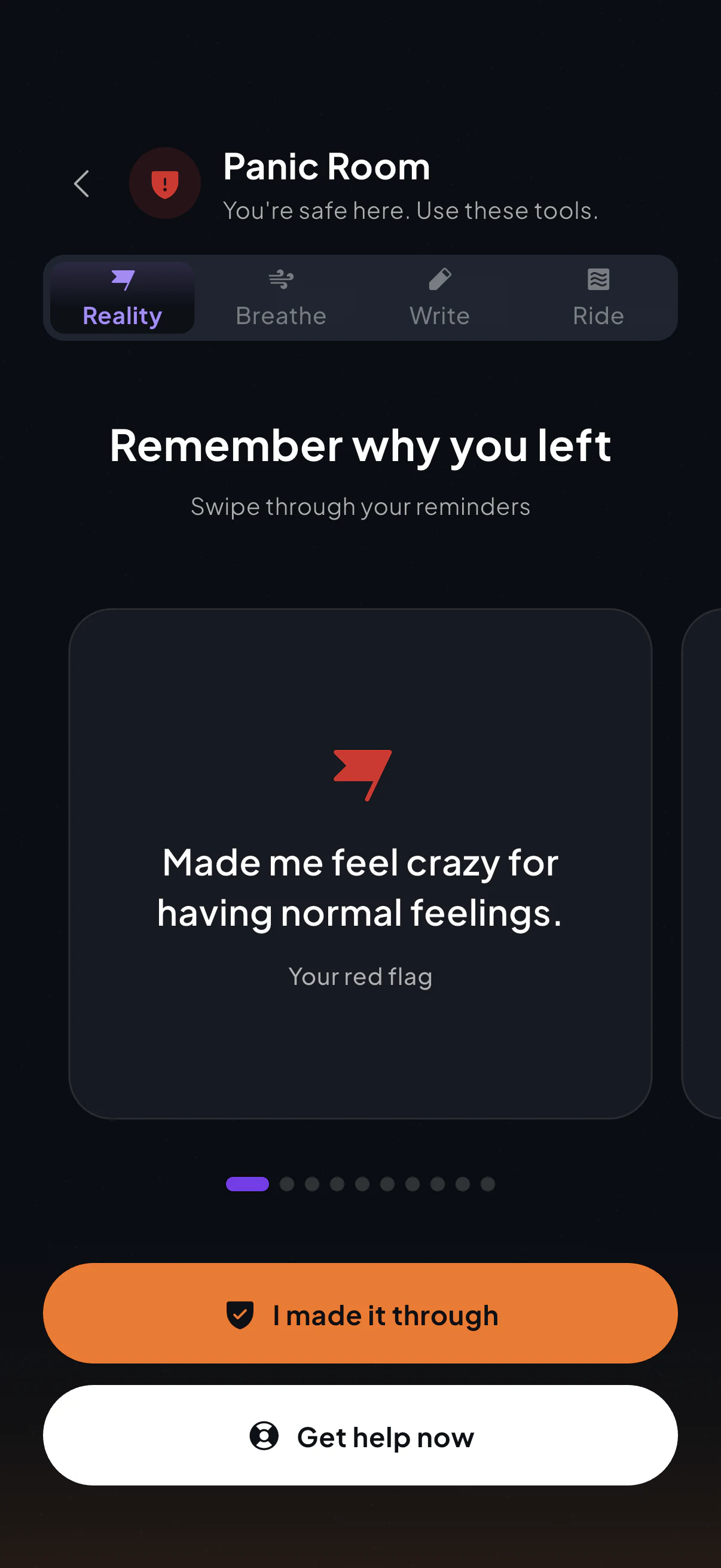
- What did you write down when it was fresh? You knew more then than you do at 1am now. Read that list before any meeting, not after — the app keeps yours for exactly this.
No score, on purpose. A percentage would only tell you what the person who built the calculator thinks, dressed up as arithmetic.
How the audit is worked out
There is no score on this page and there is no percentage, on purpose. Six questions are asked, your own answers are handed back to you in your own words, and the research is stated beside them. A number would be the tool deciding and then dressing the decision up as arithmetic, and nothing in the literature supports a number about one couple.
One thing is read rather than repeated. The box asking what has changed since is checked against three patterns, in order. First, whether the text describes something that already happened or has been happening — a past-tense act, or a stretch of time. Second, whether it is a statement about the future or about what somebody said, which is a plan rather than a changed circumstance however sincerely it was made. Third, whether it is a statement about how somebody feels, because feelings changing is not circumstances changing. Under twenty-five characters it is treated as too thin to read at all, and when the text is ambiguous the page says nothing and simply shows you what you wrote — which is the part doing the work.
Those three word lists are ours and none of them is complete. They exist to name the difference between "they moved back in March" and "they say they will change", which is the only distinction on this page that matters, and they are not a judgement about your particular sentence.
The research is quoted rather than applied. Reunions are common among young adult daters, and Dailey and colleagues found that on-again, off-again partners report more conflict, more uncertainty and lower satisfaction on average than partners who never split. Most of that work samples students and young adults, so it is a pattern in a population and not a verdict on you. The page says that where it says the finding.
Where these numbers come from
- On-again/off-again dating relationships: how are they different from other dating relationships? — Dailey et al., Personal Relationships, 2009
Nothing on this site is medically reviewed and nobody here is a therapist. Every figure above was read out of the code that runs on this page, and where a number is our own judgement rather than a published one, the note says so and cites nothing. Method last checked 21 August 2026.
What the research on going back actually measured
Search whether to get back with an ex and you get percentages: enter six answers, receive a number. There is no study under those numbers. What does exist is a body of work on what on-again, off-again relationships are like, which is a different question, and it is worth reading before you decide anything.
Who was in these studies
The prevalence figures come from young people. Nearly half of 792 daters and cohabitors aged 17 to 24 in one Ohio county reported a breakup followed by a reunion with the same partner (Halpern-Meekin and colleagues, 2013). Almost two thirds of 445 US college students said they had been in an on-and-off relationship (Dailey and colleagues, 2009). In that college research, on-off partners reported fewer positives such as love and feeling understood, and more negatives such as communication problems and uncertainty, than partners who had never split; more renewals went with more of the negatives. A study of 545 adults in same-sex and different-sex relationships found cycling associated with more symptoms of depression and anxiety (Monk and colleagues, 2018). All of it is American, most of it young, most of it surveyed once rather than followed through time. It describes an average, and averages contain the couples for whom it worked.
Why "chances" is the wrong shape
A calculator implies the future is a dice roll you can read early. It is not. It is a set of conditions you can check, and the check is the same whether it ended over distance or over how someone treats you: is the thing that ended it different now, in a way you could describe to somebody who was not there? That is answerable tonight. A probability is not. The most common reason people gave for renewing was lingering feelings — missing the person (Dailey and colleagues, 2011). Missing someone is present whether or not anything changed, which is why the audit asks you to write the change down and then hands it back to you in your own words.
When going back goes better
The same literature reports that some partners use the break itself to improve what broke (Dailey, 2015). Nobody has run the trial that tells you which reunions last, so what follows is reasoning rather than a finding: the reunions with something under them tend to have a cause that was addressed, both people choosing it rather than one person wearing the other down, and evidence outside the conversation — months of a different pattern, a move that already happened, a decision someone made when no reunion was on the table. If you are waiting on how long this takes instead, that is a different page, and no contact is what deciding in advance looks like.
Frequently asked questions
Is this a quiz?
What does the research say about getting back together?
We broke up over circumstances. Is that different?
They say they have changed.
Should I meet them to decide?
More tools
No Contact Counter
The days since you last reached out, ticking. Put in your date, keep the link, and the count is there whenever you open it.
Unsent Letter
Say the thing you cannot send. Write it here, burn it here, and let the sentences stop circling at 1am.
Urge Timer
The urge is loudest in the first ten minutes. Start the ring, keep your hands busy, and let it pass without sending anything.
The list you wrote when it was fresh
Ghosted keeps your reasons for leaving where you can reread them at 1am, next to the days since you last reached out. Both live on your phone, with no account and no server.